
The Governing Layer Above Execution.
HALO™ (Human Authority Verification Framework) is a patent-pending governance and operational oversight architecture developed by Perception Legacy Group LLC. It is designed to verify authority before execution, maintain continuity during operational movement, and preserve accountability after execution—ensuring institutional control across complex systems and environments.
HALO™ Governance Architecture
HALO™ is structured as a layered governance framework that aligns authority, operational movement, and institutional accountability across complex environments. Rather than functioning as a workflow tool or approval system, HALO™ governs how authority is verified, how execution is allowed to move forward, and how accountability is preserved across the full lifecycle of activity.

Authority verification
Ensures that proper human authority is present, aligned, and validated before execution is allowed to proceed within the operational environment.

Execution Governance
Provides a governing structure around how execution moves forward, maintaining institutional control without replacing the systems performing the action. (SHIFTGUARD CLINICAL™)

Movement continuity
Supports continuity across transitions, handoffs, and operational flow, reducing fragmentation and maintaining oversight throughout execution movement.

Accountability Preservation
Maintains traceability and institutional accountability after execution, ensuring actions can be reviewed, validated, and supported with governance-backed context.

Governance Alignment
Aligns authority, responsibility, and operational behavior across systems, teams, and environments under a consistent governance structure.

Institutional Oversight Layer
Positions HALO™ above operational systems to reinforce oversight without interfering with system functionality or execution processes.
HALO™ Operational Flow
HALO™ operates through a structured flow that aligns authority, guides operational progression, and preserves institutional integrity across the lifecycle of activity. This flow does not function as a task sequence or workflow engine. It represents how governance is maintained as actions move through an environment—ensuring that control, visibility, and responsibility remain intact from initiation through completion.

STEP 1 Authority Alignment
Every action begins within a defined authority structure. HALO™ reinforces alignment between responsibility and role, ensuring that actions originate from recognized and appropriate sources of control.

STEP 2 Governed Advancement
As activity progresses, HALO™ maintains structured advancement—ensuring that movement is not only permitted, but properly aligned with institutional expectations and oversight conditions.

STEP 3 Continuity of Movement
Operational flow is sustained across transitions, preventing disruption, fragmentation, or loss of oversight as actions move between systems, roles, or stages.

STEP 4 Post-Execution Integrity
Once activity is complete, HALO™ preserves the integrity of the event by maintaining visibility into how it occurred, who was responsible, and how it aligns with institutional standards.

STEP 5 Governance Across the Lifecycle
HALO™ ensures that operational movement is not only executed—but governed, aligned, and preserved across its entire lifecycle.
HALO™ Framework Structure
HALO™ (Human Authority Verification Framework) operates as a structured governance system designed to maintain authority, alignment, and continuity across the full operational pipeline. This structure reflects how authority is established, how movement is governed, and how accountability is preserved before, during, and after execution. Rather than functioning as isolated stages, HALO™ maintains a continuous governance presence across the lifecycle of operational activity, ensuring that decisions remain aligned, actions remain controlled, and outcomes remain verifiable under varying conditions. The structure below represents this model as an integrated governance framework, where each HALO™ extension supports a distinct layer of oversight, protection, continuity, and post-execution validation. From initial authority validation through execution and beyond, HALO™ preserves operational structure, traceability, and continuity across time.
HALO Architecture Flow
HALO operates as a continuous governance structure—aligning authority, guiding operational movement, and preserving accountability across the full lifecycle of execution.





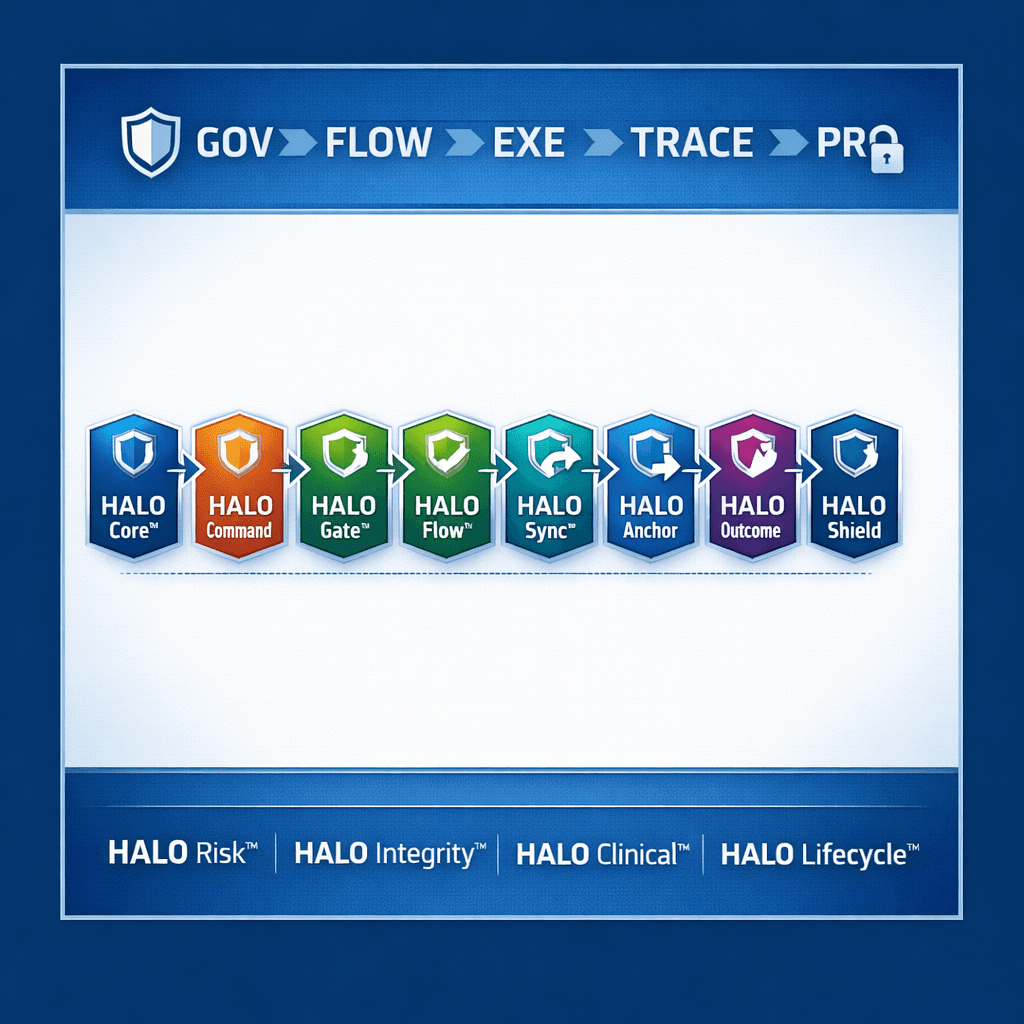
HALO™ Pipeline Structure

HALO™ Extensions
HALO™ extensions operate as structured governance layers that establish authority, guide decision control, maintain process continuity, validate conditions, and ensure that operational movement remains aligned across the pipeline. Together, they support data integrity, enforce protection, preserve stability under disruption, track actions, validate outcomes, strengthen readiness, and maintain alignment across environments—ensuring continuity before, during, and after execution.
HALO Core™ Core Governance
Foundational Governance Layer. Establishes the base structure for authority validation and framework alignment across the operational environment.
HALO Command™ Core Governance
Authority & Oversight Layer. Represents the structure of decision control and oversight, maintaining clarity of authority across execution environments.
HALO Gate™ Core Governance
Decision Control Layer. Governs whether operational actions should proceed, ensuring alignment with authority, timing, and contextual conditions before execution occurs. Enhances decision control by incorporating risk-informed logic, allowing actions to be conditionally approved, escalated, or restricted based on contextual risk levels.
HALO Flow™ Flow & Operation
Movement & Continuity Layer. Supports the continuity of operational movement across transitions, ensuring alignment, proper sequencing, and controlled progression as activity moves through each stage of execution.
HALO Anchor™ Flow & Operation
HALO Anchor™ Continuity & Stability Layer. Maintains governance continuity in environments where systems become disrupted, disconnected, or degraded, preserving structure and authority under all conditions.
HALO Outcome™ Execution & Traceability
Result Validation Layer. Extends result validation by monitoring outcome consistency over time, identifying deviations between expected and actual results, and supporting continuous performance alignment. Ensures that execution outcomes remain aligned with intended actions, preserving confidence in operational results.
HALO Audit™ Execution & Traceability
Traceability & Accountability Layer. Supports post-execution visibility, preserving the ability to review, validate, and trace actions, decisions, and outcomes across the operational environment.
HALO Shield™ Enforcement & Protection
Protection & Enforcement Layer. Reinforces governance integrity in environments where risk, breakdown, or accountability exposure may occur. Expands protection through active enforcement, enabling the system to restrict, pause, or prevent execution when integrity or risk conditions fall outside acceptable thresholds.
HALO Signal™ Enforcement & Protection
Data Integrity & Awareness Layer. Maintains awareness of operational inputs and system conditions, ensuring that decisions are supported by reliable and aligned information. Enhances awareness by detecting inconsistencies, abnormal inputs, and early signs of system misalignment—supporting real-time identification of integrity concerns before decisions proceed.
HALO™ Extended Operational Layers
These layers support system readiness and environmental alignment—preserving performance stability, reinforcing operational consistency, and ensuring continuous realignment as conditions evolve.

HALO Train™ Alignment & Readiness
Alignment & Readiness Layer. Supports institutional alignment through governance-informed readiness and operational conditioning. Strengthens readiness by maintaining consistent alignment as systems evolve, ensuring conditions remain aligned with governance expectations across changing environments.
HALO Sync™ Flow & Operation
Flow & Operation / Reconnection & Alignment Layer. Supports the realignment of operational environments following disruption, ensuring continuity and consistency as systems transition back into connected and stable states.

HALO™New Intelligent Layers
HALO™ New intelligent layers expand governance through cyber integrity, risk intelligence, clinical alignment, and lifecycle continuity—ensuring every decision remains verified, protected, and sustained across all operational conditions.
HALO Risk™
Risk Intelligence & Intervention Layer. HALO Risk™ introduces structured risk awareness into the operational environment, ensuring that decisions are not only authorized, but understood in terms of their potential impact, exposure, and consequence. It evaluates operational actions within context—assessing conditions, thresholds, and sensitivity of the environment—to determine the level of risk associated with proceeding. This includes identifying potential harm, instability, or misalignment that may not be visible through authority validation alone. HALO Risk™ works alongside HALO Gate™ and HALO Command™ to ensure that decisions are not only permitted, but appropriate given the level of exposure present. It supports escalation pathways, conditional approvals, and controlled intervention when risk exceeds acceptable thresholds. By embedding risk intelligence into governance, HALO Risk™ ensures that every action is not only authorized—but responsibly executed.
HALO Integrity™
System Integrity & Trust Assurance Layer. HALO Integrity™ ensures that the systems, data, and conditions supporting operational decisions remain authentic, unaltered, and reliable throughout the lifecycle of activity. It validates that inputs, models, and system behaviors have not been compromised, manipulated, or degraded—preserving trust in the environment in which decisions are made. This includes awareness of system dependencies, structural consistency, and alignment between expected and actual system states. Expanding upon HALO Signal™ and HALO Shield™, HALO Integrity™ introduces a deeper layer of verification that protects against hidden disruption, unauthorized influence, or silent system failure. By ensuring that what is being relied upon is intact and trustworthy, HALO Integrity™ protects the foundation upon which all governance decisions are made.
HALO Clinical™
Clinical Alignment & Decision Context Layer. HALO Clinical™ introduces domain-specific awareness into healthcare and life science environments, ensuring that decisions are aligned not only with governance—but with clinical context, patient conditions, and care standards. It supports the structured integration of clinical logic, ensuring that actions taken within the environment reflect appropriate use, intended purpose, and situational relevance. This includes alignment with care pathways, treatment conditions, and operational boundaries within clinical settings. HALO Clinical™ works in coordination with HALO Risk™, HALO Gate™, and HALO Outcome™ to ensure that decisions are not only authorized and executed—but appropriate within the context of patient care and clinical intent. By embedding clinical understanding into governance infrastructure, HALO Clinical™ ensures that operational decisions reflect not just authority—but responsibility to the environment in which they occur.
HALO Lifecycle™
Operational Continuity & Evolution Layer. HALO Lifecycle™ introduces structured continuity across the full lifespan of operational systems, ensuring that changes, updates, and ongoing activity remain aligned with governance expectations over time. It maintains awareness of how systems evolve—tracking transitions, adjustments, and progression of operational states—while preserving alignment with original authority, purpose, and intended outcomes. Expanding upon HALO Train™ and HALO Outcome™, HALO Lifecycle™ ensures that readiness, performance, and system behavior remain consistent, even as environments shift or develop. By maintaining continuity beyond initial execution, HALO Lifecycle™ ensures that governance is not a moment—but a sustained condition across time.
Built for Institutional Environments
HALO™ is structured for environments where responsibility, operational action, and outcome accountability must remain clearly defined and consistently maintained. Its architecture supports sectors that operate under high standards of control, including healthcare systems, industrial operations, enterprise infrastructures, and regulated institutions. Rather than functioning within a single process or platform, HALO™ is designed to sit above existing environments—supporting structured oversight, reinforcing role clarity, and maintaining alignment across complex operational activity.
Institutional Access & Licensing
HALO™ is part of the Perception Legacy Group LLC infrastructure portfolio and is introduced through structured access and licensing pathways. Engagement is intended for organizations and leadership teams seeking a governance-centered approach to managing responsibility, operational progression, and institutional visibility across their environments. This is not a standard onboarding model. Access is aligned with evaluation, architectural fit, and long-term integration considerations at the institutional level.
Authority Should Exist Before Action.
In environments where outcomes carry consequence, oversight cannot begin after the event has already taken place. HALO™ was developed to support clear authority at the point of origin, maintain structured control as activity progresses, and retain visibility after completion—ensuring that responsibility remains connected throughout the full lifecycle of operational activity.
Confidential Access & Disclosure
Certain components of the HALO™ framework, including extended architecture, operational logic, and system integrations, are not publicly disclosed. Access to detailed system information, technical specifications, and deployment structure requires a signed Non-Disclosure Agreement (NDA). For serious inquiries, partnerships, or implementation discussions, please submit a request and specify your area of interest. NDA documentation will be provided upon review.
HALO™ Inquiry Submission
Organizations seeking to explore the integration of HALO™ within their operational environment may submit an inquiry below. All submissions are reviewed by Perception Legacy Group LLC. Qualified inquiries will be contacted to discuss governance alignment, system integration, and licensing considerations.

Organizations seeking to engage with Perception Legacy Group LLC may submit an inquiry below. All submissions are reviewed in accordance with organizational scope, availability, and alignment.